The new castle of Perchtoldsdorf, with fictional windows in time.
A century project: Perchtoldsdorf Castle is not only an architectural achievement but also filled with an artistic soul.
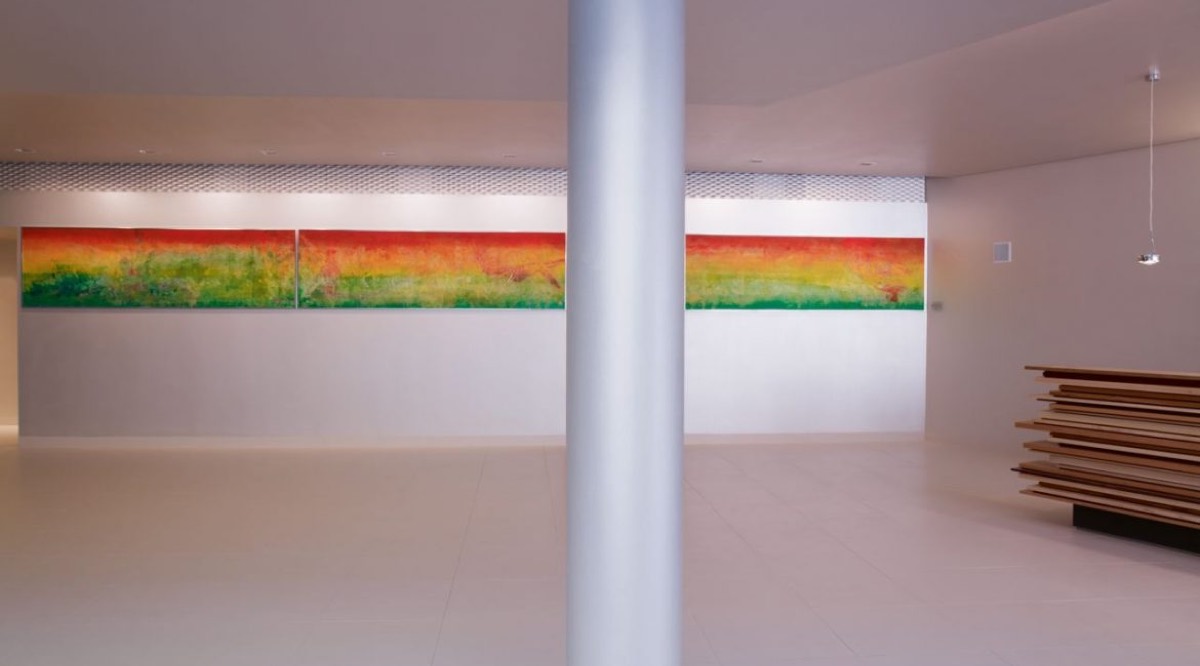
Vienna / Perchtoldsdorf. Some connoisseurs of art had not yet directly noticed Christian Franz Joseph König. Since the opening of the new cultural centre at Perchtoldsdorf Castle at the latest, that has changed: the internationally active Perchtoldsdorf painter is on everyone's lips. The reason is the 11.5-metre frieze “born” in the lower floor of the new castle and the 9.5-metre triptych “experience” on the upper floor of the architecturally accomplished extension to the historic building. The artist created both works in 2009 and 2010.
Mayor Martin Schuster, who commissioned the works for the municipality of Perchtoldsdorf, is delighted: “The brief was to create a frieze building a bridge from the past through the present into the future. König has more than fulfilled it. He has given our castle a kind of soul.”
In the frieze “born” König engages with genesis; where we come from, who we are and where we are going becomes, in this work, a fictional window in time. Through emotional transitions he grants glimpses into the unconscious. The seduction into his inner world of shadings and figures becomes a school of seeing for every viewer.
In the triptych “experience” the artist's engagement with life becomes the main statement. The appetite for life in the here and now, the colourful bustle of airy beings as mere suggestion, appears half flat and in the next moment spatially shifting again — in a glance flying across the format, at once representational and abstract.
Pictures for the eternal fathoming of the riddle of life will never grow boring, because they offer many variations from the most varied angles of view, through the layering technique in acrylic with pigments that he developed.
Representation — but hidden, please. By his own admission C.F.J. König paints representationally, although at first glance his pictures are not representational, do not correspond to the prototypes of figurative painting, and the visible world does not seem to be present in them.
Numerous journeys with longer stays have deepened the artist's engagement with old cultures, whose mythological and spiritual content inspires him artistically. Retrospection, introspection, foresight and confrontation flow seamlessly together.
One might describe his spatial compositions as “discontinuous painting”. In the most recent works especially it becomes clear how space as a continuum is almost entirely dissolved — how the spatial representation of a figure or portrait reaches areas that can no longer be identified unambiguously as space or as surface.
Painting as a material activity, as procedure and process, and the painting as a many-layered material body have — looking at his work over a longer period — moved ever more into the foreground. The action of making has steadily gained in importance.
He plays with the possibilities of perceiving figurative representation: like other living creatures, we humans are programmed to respond to particular, and not very numerous, visual key stimuli. Setting those stimuli, so that the viewer can receive his works, has become more and more the artist's task.
His works constitute a closed system holding several meanings. Disorder seems to reign in them — and they open up possibilities. Much of what is to be seen in the pictures has, at first glance, no connection to the rest. But by letting the contents seep in, the various details take on a relation to one another. We do, after all, live in a world that is at times staged. And C.F.J. König's pictures establish relations to our real world.